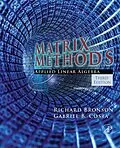
Matrix Methods: Applied Linear Algebra, Third Edition, as a textbook, provides a unique and comprehensive balance between the theory and computation of matrices. The application of matrices is not just for mathematicians. The use by other disciplines has grown dramatically over the years in response to the rapid changes in technology. Matrix methods is the essence of linear algebra and is what is used to help physical scientists; chemists, physicists, engineers, statisticians, and economists solve real world problems. - Applications like Markov chains, graph theory and Leontief Models are placed in early chapters - Readability- The prerequisite for most of the material is a firm understanding of algebra - New chapters on Linear Programming and Markov Chains - Appendix referencing the use of technology, with special emphasis on computer algebra systems (CAS) MATLAB
Autorentext
Richard Bronson has written several books and numerous articles on Mathematics. He has served as Interim Provost of the Metropolitan Campus, and has been Acting Dean of the College of Science and Engineering at the university in New Jersey.
Klappentext
Matrix Methods: Applied Linear Algebra, Third Edition, as a textbook, provides a unique and comprehensive balance between the theory and computation of matrices. The application of matrices is not just for mathematicians. The use by other disciplines has grown dramatically over the years in response to the rapid changes in technology. Matrix methods is the essence of linear algebra and is what is used to help physical scientists; chemists, physicists, engineers, statisticians, and economists solve real world problems.
- Applications like Markov chains, graph theory and Leontief Models are placed in early chapters
- Readability- The prerequisite for most of the material is a firm understanding of algebra
- New chapters on Linear Programming and Markov Chains
- Appendix referencing the use of technology, with special emphasis on computer algebra systems (CAS) MATLAB
Inhalt
Chapter 1: Matrices
Chapter 2: Simultaneous Linear Equations
Chapter 3: The Inverse
Chapter 4: Linear Programming
Chapter 5: Determinants
Chapter 6: Eigenvalues and Eigenvectors
Chapter 7: Matrix Calculus
Chapter 8: Linear Differential Equations
Chapter 9: Markov Chains
Chapter 10: Real Inner Products and Least Squares
Appendix: Computational Tools and technology