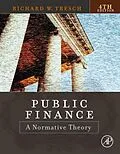
Public Finance: A Normative Theory, Fourth Edition provides a classic text on the normative theory of government policy. This valuable and accessible resource covers the welfare aspects of public economics, with considerable coverage of European examples. The work presents detailed and comprehensive coverage of theoretical literature, empirical work, environmental issues, social insurance, behavioral economics and international tax issues. The book is organized logically, written in an engaging manner, and is both sufficiently rigid for use by those with PhDs in math and accessible to students less well trained in math. - Provides a logical progression from normative theory to concise mathematical applications - Covers European examples, welfare economics and tax law updates - Includes pedagogical supplements such as end-of-chapter questions and answers
Autorentext
Professor Richard W. Tresch earned a bachelor's degree from Williams College in 1965 and a doctorate in economics in 1973 from Massachusetts Institute of Technology, where he was a teaching assistant prior to his arrival at Boston College. He joined the Boston College faculty in 1969 and throughout his 43-year career has served as Chairman of the Department of Economics, Director of Graduate Studies, and Director of Undergraduate Studies.
In 1996, chosen as Massachusetts Professor of the Year by the Carnegie Foundation for the Advancement of Teaching. He was one of 585 national entrants in the foundation's US Professors of the Year Program, which salutes outstanding undergraduate instructors; its award is recognized as one of the most prestigious honors bestowed upon professors. "I am quite humbled by the award, and extremely grateful to the Carnegie Foundation," Tresch said. "The greatest honor, however, is to have been nominated by Boston College. There are so many good teachers here and to be chosen to represent them in the program is something I truly value."
A member of the American Economic Association, Tresch served on the board of editors for the American Economic Review, and has contributed to New England Journal of Business and Economics and Public Finance. He is the editor of a four-volume major reference work on public sector economics.
The third edition on his textbook, Public Finance: A Normative Theory publishes in November, 2014.
Klappentext
The welfare aspects of public economics will receive extensively renewed examination in this Third Edition. With four new chapters and other significant revisions, it will present detailed and comprehensive coverage of theoretical literature, empirical work, environmental issues, social insurance, behavioral economics, and international tax issues. With increased emphasis on the European Union, it will be rigid enough for use by Ph.D.'s while being accessible to student less well trained in math. Public Finance remains the premier textbook on the normative theory of government policy, with the Third Edition propelling into the 21st century its examination of what government ought to be doing instead of what it is doing.
* Moves skillfully from explaining normative theory to applying it in mathematically compact and precise terms.
*Adds four new chapters on social insurance, medical care, social security pensions, behavioral public economics, and international public finance.
*Includes new pedagogical supplements, including end-of-chapter questions and answers.
*Emphasizes European examples
Inhalt
Part I: Introduction: The Content and Methodology of Public Sector Theory
3 chapters
Part II: The Theory of Public Expenditures and Taxation-First-Best Analysis
8 chapters
Part III: The Theory of Public Expenditures and Taxation: Second-Best Analysis
14 chapters
Part IV: Fiscal Federalism and International Public Finance
4 chapters