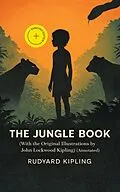
Rudyard Kipling's The Jungle Book is a richly patterned collection of animal fables, adventure tales, and moral allegories set chiefly in the Indian jungle. Centered on Mowgli, the child raised by wolves, and figures such as Baloo, Bagheera, Shere Khan, and Kaa, the book blends oral storytelling, imperial-era romance, and mythic initiation narrative. Its prose is rhythmic, vivid, and epigrammatic, while its poems and songs deepen the sense of a self-contained natural law. This edition, with John Lockwood Kipling's original illustrations, restores an important visual dimension to the work's first imaginative world. Kipling was born in Bombay in 1865 and spent formative childhood years in India, an experience that profoundly shaped his landscapes, languages, and symbolic imagination. His father, John Lockwood Kipling, was an artist, teacher, and curator whose knowledge of Indian craft and design helped inform the book's visual and cultural texture. Readers seeking a classic that is both enchanting and intellectually layered will find The Jungle Book indispensable. It rewards children with adventure and memorable characters, while offering adults a complex meditation on law, belonging, exile, education, and the fragile boundary between civilization and the wild. This enriched edition has been carefully crafted to add value to your reading experience. - A comprehensive Introduction outlines these selected works' unifying features, themes, or stylistic evolutions. - The Author Biography highlights personal milestones and literary influences that shape the entire body of writing. - A Historical Context section situates the works in their broader era-social currents, cultural trends, and key events that underpin their creation. - A concise Synopsis (Selection) offers an accessible overview of the included texts, helping readers navigate plotlines and main ideas without revealing critical twists. - A unified Analysis examines recurring motifs and stylistic hallmarks across the collection, tying the stories together while spotlighting the different work's strengths. - Reflection questions inspire deeper contemplation of the author's overarching message, inviting readers to draw connections among different texts and relate them to modern contexts. - Lastly, our hand-picked Memorable Quotes distill pivotal lines and turning points, serving as touchstones for the collection's central themes.
Klappentext
This carefully crafted ebook: "The Jungle Book (With the Original Illustrations by John Lockwood Kipling)" is formatted for your eReader with a functional and detailed table of contents. The Jungle Book is a collection of stories. The tales in the book are fables, using animals in an anthropomorphic manner to give moral lessons. The verses of The Law of the Jungle, for example, lay down rules for the safety of individuals, families and communities. Kipling put in them nearly everything he knew or "heard or dreamed about the Indian jungle." The best-known of them are the three stories revolving around the adventures of an abandoned "man cub" Mowgli who is raised by wolves in the Indian jungle. The most famous of the other four stories are probably "Rikki-Tikki-Tavi", the story of a heroic mongoose, and "Toomai of the Elephants", the tale of a young elephant-handler. As with much of Kipling's work, each of the stories is preceded by a piece of verse, and succeeded by another. Joseph Rudyard Kipling (1865-1936) was an English short-story writer, poet, and novelist. He wrote tales and poems of British soldiers in India and stories for children. He is regarded as a major innovator in the art of the short story; his children's books are classics of children's literature; and one critic described his work as exhibiting "a versatile and luminous narrative gift".