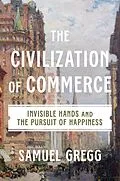
One of humanity's greatest achievements is the market economy. Since the late-eighteenth century, it has radically reduced poverty and created opportunities for millions who might otherwise have been condemned to lives of misery. Yet despite these accomplishments, markets have long been accused of causing profound injustices and creating a stultifying materialism that impoverishes the human soul.
But markets are much more than engines of wealth. In The Civilization of Commerce, prize-winning author Samuel Gregg demonstrates that commercial society is a civilizational achievement worthy of emulation. Drawing on the thought of Nobel economist F. A. Hayek and Scottish Enlightenment luminaries such as Adam Smith, Gregg shows how commercial civilization enables individuals to overcome ignorance and isolation, build societies rooted in liberty and justice, and, above all, improve their lives.
Commercial civilization, however, is a fragile achievement, and it faces perennial threats: from rationalizers who seek ever-growing top-down control over our lives, and romantics who reject complexity and idealize a poorer, less free world. As Gregg shows, these regressions erode the rule of law, stifle innovation, and deliver us into new forms of servitude.
Resisting these challenges requires more than good policies. It demands a culture grounded upon knowledge, dynamism, and institutions that, together, deliver freedom, order, and economic growth. Advancing commercial society, Gregg argues, means embracing it as a civilizational imperative and a mandate for greatness. To skeptics and defenders of markets alike, The Civilization of Commerce offers a framework for understanding and extending a society where prosperity and purpose converge, and reminds us that true progress demands wisdom, discipline, creativity, and a choice for liberty.
Autorentext
Samuel Gregg is president of the American Institute for Economic Research. The prize-winning author of seventeen books, including The Next American Economy, and hundreds of articles and opinion pieces, he writes regularly on economics and economic history in outlets including The Wall Street Journal, Foreign Affairs, Investor's Business Daily, Real Clear Markets, City Journal, The Spectator, Fox Business, The Daily Telegraph, National Review, Real Clear Politics, Engelsberg Ideas, American Banker, Law & Liberty, and Civitas Outlook. He appears frequently on American and foreign broadcast media as well as numerous podcasts.