"The growing number of elected Socialists and other progressives, including Mayor de Blasio, have given Barron enough targets to fill a book, The Last Days of New York, that even the most dyed-in-the-wool lefties ought to read. - Errol Lewis, New York Daily News "Seth Barron has covered New York for a very long time. He has a new book The Last Days of New York. The title says it all." - TUCKER CARLSON
"A must read." - BRIAN KILMEADE, host of Fox & Friends
"In this gripping new book, Seth Barron warns the city may not recover from the preening, disastrous incompetence of Mayor de Blasio.'' - RAY KELLY, Police Commissioner of New York City
"Barron cuts through the noise and provides a devastating account of a city's decline under the delusional leadership of socialists and con men." - GREG KELLY, host of Newsmax Greg Kelly Reports
BILL DE BLASIO SET THE STAGE FOR THE RUIN OF NEW YORK CITY
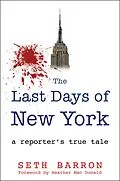
THE LAST DAYS OF NEW YORK: a reporter's true tale tells the story of how a corrupted political system hollowed out New York City, leaving it especially vulnerable, all in the name of equity and "fairness."
When, in the future, people ask how New York City fell to pieces, they can be told-quoting Hemingway-"gradually, then suddenly." New Yorkers awoke from a slumber of ease and prosperity to discover that their glorious city was not only unprepared for crisis, but that the underpinnings of its fortune had been gutted by the reckless mismanagement of Bill de Blasio and the progressive political machine that elevated him to power.
Faced with a global pandemic of world-historical proportions, the mayor dithered, offering contradictory, unscientific, and meaningless advice. The city became the world's epicenter of infection and death. The protests, riots, and looting that followed the death of George Floyd, and the resurgence of the Black Lives Matter movement-cheered on and celebrated by the media and political class-accelerated the crash of confidence that New York City needed in order to rebound quickly from the economic disaster.
Through reckless financial husbandry; by sowing racial discord and resentment; by enshrining a corrosive pay-to-play political culture that turned City Hall into a ticket office; and by using his office as a platform to advance himself as a national political figure, Bill de Blasio set the stage for the ruin of New York City.
As New Yorkers slowly adjust to their new reality, they ask themselves how we had been so unprepared-not so much for the coronavirus, which caught everyone by surprise-but for the economic shock, which was at least foreseeable. THE LAST DAYS OF NEW YORK is the story of how a lifelong political operative with no private-sector experience assumed control of a one-party city where almost nobody bothers to vote, and then proceeded to loot the treasury on behalf of the labor unions, race hustlers, and connected insiders who had promoted him to power.
Bill de Blasio's failure to manage the outbreak of Covid-19 is well established. But what is less well understood is how poorly he managed the city up to the point of the pandemic, and how his mismanagement left New York City vulnerable to the social, economic, and cultural shocks that have leveled its confidence and brought into question its capacity to absorb the creative energies of the world, and reflect them back in the form of opportunity and wealth, as it has done for hundreds of years. At a moment when socialist currents are stirring throughout America, Bill de Blasio's term in office in New York City is a demonstration of what those impulses actually produce: debt, decay, and bloat.
THE LAST DAYS OF NEW YORK: a reporter's true tale is a history of New York City from its recovery from the recession of 2008-2009 through the triple disaster of the pandemic, civil unrest, and collapse in revenue of 2020. Mayor Bill de Blasio, now widely appreciated as the WORST mayor in the history of the city, is presented as the instrument of decline: a key symptom of the rot that expedited the city's downfall.
Autorentext
Seth Barron (New York, NY) is a New York City-based reporter and editor who has covered local politics closely for more than ten years. Associate editor at urban policy journal City Journal, a publication of the Manhattan Institute, Barron is a widely-read columnist and reporter on politics and issues in New York City. Barron became intimately familiar with the ins and outs of New York City politics through his City Council Watch blog, and then worked in City Hall as legislative director for a council member from Queens. His work has appeared in the New York Post, New York Daily News, and the Wall Street Journal and also appears regularly on Tucker Carlson Tonight on Fox News to discuss New York City issues. He frequently appears on a range of local and national television and radio programs as a commentator.
The author lives & works in the New York City metro area.
Inhalt
Table of Contents to Last Days of New York: a reporter's true tale of how a city died by Seth Barron
Introduction
- Past is prologue: all of de Blasio's fumbles and misallocations of resources created a weak city that would be especially vulnerable to a major crisis.
Section One: De Blasio the Man and his Rise
Chapter One
- Who is Bill de Blasio? This chapter treats his biography, and delves into the family history of the man who legally changed his name as an adult not once, but twice inspired, he has said, by the experience of reading The Autobiography of Malcolm X.
- His paternal grandfather Donald Wilhelm was the personal secretary of Herbert Hoover-the same president whose name de Blasio condemns constantly-and interviewed William Howard Taft and Theodore Roosevelt. The chapter examines the marriage of de Blasio's parents, who were both implicated in the postwar investigations into Communist influence in public affairs.
- De Blasio's early life as a radical socialist included solidarity work with the Sandinista regime of Nicaragua, which he visited. His work in the Dinkins administration exposed him to a cauldron of racial animosity during the Crown Heights riots.
- His marriage, to a black lesbian seven years his senior, became the basis of his later political appeal, when he used his family-especially his son-as a constant feature of campaign literature.
- De Blasio worked for two figures who would become important later in his career: Hillary Clinton and Andrew Cuomo. His complicated relationship with both of them would affect his mayoralty.
Chapter Two
- De Blasio's rise to power cannot be understood without reference to the formation of the Working Families Party (WFP), a local political party that took advantage of New York's unique "fusion" voting system, whereby candidates can occupy multiple ballot lines. The WFP was the creation of labor and housing activists, and funded by major unions, including public-sector employee unions. The party had some successes, but by the 2009 election had created a Byzantine financial structure, with a complex network of associated entities, and even a for-profit arm to perform campaign work, ostensibly for non-affiliated candidates.
- Scandals emerged following the 2009 election suggesting rather strongly that the WFP engaged in rampant violation of campaign finance laws, essentially coordinating campaign work among its slate of candidates in conjunction with consulting firms-and ostensibly unrelated independent expenditures made by major unions. This corruption came to full flower in 2013 when de Blasio won the mayoral election, and is essential to understanding the many scandals that dogged his administrat…