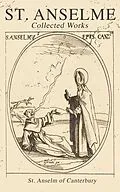
St. Anselme: Collected Works gathers the essential writings of one of the defining minds of medieval Christianity, including devotional meditations, theological treatises, prayers, and philosophical arguments. Across works such as the Monologion, Proslogion, and Cur Deus Homo, Anselm unites rigorous dialectic with contemplative intensity, giving literary form to the famous ideal of "faith seeking understanding." His prose is at once austere and ardent, situated at the threshold between patristic inheritance and scholastic method. St. Anselm of Canterbury, born in Aosta in 1033 and later abbot of Bec and archbishop of Canterbury, wrote from within the intellectual and spiritual currents of the Benedictine tradition. His experience as monk, teacher, pastor, and embattled churchman shaped a body of work concerned with reason, prayer, divine justice, freedom, and redemption. The tensions of ecclesiastical reform and philosophical inquiry are everywhere present in his thought. This collection is recommended to readers interested in theology, philosophy, medieval literature, and the history of Christian devotion. It rewards careful reading, offering not only landmark arguments for God's existence and atonement but also a profound model of disciplined spiritual intelligence. This enriched edition has been carefully crafted to add value to your reading experience. - A comprehensive Introduction outlines these selected works' unifying features, themes, or stylistic evolutions. - A Historical Context section situates the works in their broader era-social currents, cultural trends, and key events that underpin their creation. - A concise Synopsis (Selection) offers an accessible overview of the included texts, helping readers navigate plotlines and main ideas without revealing critical twists. - A unified Analysis examines recurring motifs and stylistic hallmarks across the collection, tying the stories together while spotlighting the different work's strengths. - Reflection questions inspire deeper contemplation of the author's overarching message, inviting readers to draw connections among different texts and relate them to modern contexts. - Lastly, our hand-picked Memorable Quotes distill pivotal lines and turning points, serving as touchstones for the collection's central themes.
Autorentext
Anselm of Canterbury (033/41109), also called Anselm of Aosta, was an Italian Benedictine monk, abbot, philosopher and theologian of the Catholic Church. He was famous for the service as the Archbishop of Canterbury from 1093 to 1109 and for his theological works which set standards for the development of further theological ideas. He was also noted for the resistance to the English kings William II and Henry Iamid the Investiture Controversy, where he defended the interests of the church. After his death, he was canonized as a saint. His feast day is 21 April.
Zusammenfassung
This collection includes the most important books by the medieval clergyman and philosopher St. Anselm and one work of his opponent which is necessary to for a complete understanding of the matter of discussion. The first book from the sequence, Monologion was created back in 1075. It's first title was A Monologue on the Reason for Faith. In this work, Anselm states that anyone should be able to convince themselves of the existence of God through reason alone if they are intelligent. If there is something good, there can be things greater and better. Thus, there should be one thing that is supremely good and supremely great. It should be supreme among all other existing things.In Proslogion, Anselm develops his arguments previously presented in Monologion. This work is most famous for formulation of the ontological argument for the existence of God. This argument is also known to the Scholastics as "Anselm's argument" (ratio Anselmi). According to it, even atheists can imagine a greatest being, having such attributes that nothing greater could exist. But if such a perfect being can be imagined as not existing, another perfect being can be imagined as existing, or having an attribute of existence. Thus, such a perfect being should exist. The collection also contains the book that wasn't written by Anselm but is tightly connected with his Proslogion. That is In Behalf of The Fool by Gaunilo. He was a Benedictine monk in the middle ages who contradicted St. Anselm's ontological argument. Gaunilo was an empiricist and believed that a human experience can be acquired only through senses. He stated that St. Anselm was wrong because the logic of the same kind would force one to conclude many things existed which certainly didn't. In Cur Deus Homo, that is often translated like Why God Was A Man, Anselm speculates on the topic of atonement, that is the salvation of humans through the crucifixion of Jesus Crist. He writes that thought the history the humans made too many sins for an adequate restitution and to save the humanity, deemed for devastation, God sent Jesus. Jesus is a sinless being both divine and human, that made him able to pay for the sins of humankind by his death. Cur Deus Homo is considered one of the greatest works of Anselm and it had an immense importance in the development of the further church doctrine.