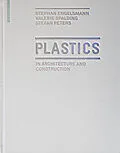
Kunststoffe sind hochleistungsfähige Werkstoffe, die seit geraumer Zeit Anwendung in der Architektur finden. Sie faszinieren durch vielfältige technische Eigenschaften. Neben diesen macht ein breites Spektrum an Formgebungs- und Bearbeitungsmethoden das Material interessant für komplexe Geometrien in Verbindung mit digitalen Planungsprozessen. Nach den Pionierbauten der 1970er Jahre hat in jüngster Zeit eine Reihe von aufsehenerregenden Bauwerken erneut den Fokus auf das technische und ästhetische Potential von Kunststoffen gelenkt.
Bislang fehlte allerdings eine umfassende Darstellung zur Verwendung von Kunststoff in der Architektur. Das vorliegende Buch schließt diese Lücke und bietet eine Einführung in die konstruktiven und gestalterischen Möglichkeiten des Werkstoffs. Es werden nicht nur Kunststoffe und ihre Eigenschaften, sondern auch Herstellung, Verarbeitung und Konstruktionsprinzipien beschrieben und für die Architektur relevante Kunststoffprodukte und -halbzeuge vorgestellt. Eine Auswahl von ca. 25 internationalen gebauten Projekten, geordnet nach Kunststoffarten und Einsatzgebiet, dokumentiert die Anwendungen von Kunststoff in der Architektur. Ein Ausblick erläutert Tendenzen in der Forschung.
Autorentext
Prof. Dr.-Ing. Stephan Engelsmann is a civil engineer; he did his studies at the Technische Universität München (Technical University of Munich). He also studied architecture at the University of Bath. He then worked as a research associate at the chair of Jörg Schlaich. Since 2002, he has been a professor of structural engineering and design at the Staatliche Akademie der Bildenden Künste Stuttgart (Stuttgart State Academy of Art and Design). In addition, he is a founding partner of the firm Engelsmann Peters Beratende Ingenieure in Stuttgart.
Valerie Spalding did her studies of architecture at RWTH Aachen (RWTH Aachen University). She has worked at a number of different architecture firms in Germany and abroad, including James Carpenter Design Associates in New York. Since 2005, she has been a research associate at the Staatliche Akademie der Bildenden Künste Stuttgart; the focus of her research is plastics in architecture.
Stefan Peters is a civil engineer; he did his studies at Universität Stuttgart (Stuttgart University). He has worked at a number of different engineering firms, including Werner Sobek Ingenieure. From 2000 to 2006, he was a research associate at Universität Stuttgart, and he has been a partner at the firm Engelsmann Peters Beratende Ingenieure in Stuttgart since.
Inhalt
Preface
1 The development of plastic architecture
PRINCIPLES
2 Material properties of plastics
2.1 Forming characteristics and the manufacture of building elements
2.2 Resistance to environmental effects
2.3 Mechanical properties
2.4 Thermal properties
2.5 Flammability and fire performance
2.6 Additives, fillers and reinforcing materials
3. Basics of plastics
3.2 Polymer structure
3.3 The morphology of macromolecules
3.4 The classification of plastics according to their degree of cross-linking
3.5 Synthesising techniques
4. Plastics and their manufacture
4.1 Elastomers
4.2 Thermoplastics
4.2.1 Types
4.2.2 Manufacture
4.2.3 Working methods
4.2.4 Recycling
4.3 Thermosets
4.3.1 Material components
4.3.2 Manufacture
4.3.3 Properties
CONSTRUCTION
5. Finished and semi-finished products
5.1 Solid sheets and panels
5.2 Profiled sheets and panels
5.3 Sandwich panels
5.4 Foams
5.5 Profiles
5.6 Special products
6. Building with plastics
6.1 Thermoplastics
6.1.1 Screwing
6.1.2 Clamping
6.1.3 Bonding
6.1.4 Welding
6.2 Thermosetting plastics
6.2.1 Screwing
6.2.2 Bonding
6.2.3 Dimensioning
6.2.4 Stability and durability
CASE STUDIES
7 Plastics as building envelope
Chanel Mobile Art Pavilion
Hong Kong, China; Tokyo, Japan; New York, USA
BMW Bubble
Frankfurt and Berlin, Germany
Kunsthaus Graz
Graz, Austria
Railway station Emsdetten
Emsdetten, Germany
Idee Workstation
Tokyo, Japan
Reiss Headquarters
London, United Kingdom
Fiberline Composites factory and offices
Middelfart, Denmark
Farben des Konsums
Berlin, Germany
Laban Creekside
London, United Kingdom
Terminal V
Lauterach, Austria
Forum Soft
Yverdon, Switzerland
Polymer Engineering Centre
Melbourne, Australia
Dornier Museum
Friedrichshafen, Germany
Congress centre and auditorium
Badajoz, Spain
8 Plastics as building structure
Plastic tower sculpture
Stuttgart, Germany
D-Tower
Doetinchem, Netherlands
Hoofddorp bus station
Hoofddorp, Netherlands
Roof Yitzhak Rabin Centre
Tel Aviv, Israel
GRP-Glass-Pavilion
Düsseldorf, Germany
9 Plastics as building structure and envelope
Clip-On
Utrecht, Netherlands
Eiertempel
Bern, Switzerland
Five Bubbles
Vienna, Austria
fg 2000
Altenstadt, Germany
Futuro
different locations worldwide
MYKO
Weimar and Rostock, Germany
Novartis Campus reception building
Basel, Switzerland
10 Future developments
High-performance material for supporting structures
High-performance material for building envelopes
Composite materials
Reinforcement of supporting structures
Joining technologies appropriate to the material
New production methods
Technology transfer
Glossary
Bibliography
About the authors
Acknowledgements
Name and building index
Subject index
Illustration credits