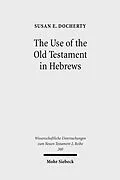
Susan Docherty argues that the Letter to the Hebrews can be better understood if it is read seriously as an example of first century Jewish biblical interpretation. Her study therefore engages with the question of the date and implications of the 'parting of the ways' between early Judaism and Christianity, and then introduces the reader to some of the highly sophisticated contemporary aproaches to analyzing the exegetical techniques present in the Jewish midrashim. These methods are applied to two sections of Hebrews in which the citation and interpretation of the Old Testament is central to the author's argument, the catena of citations in Hebrews chapter 1 and the sustained exegesis of a longer scriptural text in chapters 3-4. This results in a new and more precise explanation of the interpretative techniques at work in Hebrews, and of the often neglected question of the underlying axioms they reveal about the nature of scripture. A full discussion is also included of the variety of Septuagintal sources underlying the citations in these chapters. This study therefore seeks to make a contribution to an understanding of exegetical methods and principles in Hebrews and more widely in Second Temple Judaism, and its findings can potentially be applied to other NT and early Christian writings.
Born 1965; 1986 BA (Hons) Theology and Religious Studies Class I University of Cambridge; 1990 MA University of Cambridge; 2000 MPhil Old Testament and Inter-Testamental Studies University of Cambridge; 2008 PhD University of Manchester; Head of Theology and Principal Lecturer in Biblical Studies, Newman University College, Birmingham, UK.
Autorentext
Zusammenfassung
Susan Docherty zeigt, dass der Hebräerbrief sich dem Leser besser erschließt, wenn er als Beispiel für frühjüdische Bibelinterpretation gelesen wird. Dabei lässt sie nicht außer Acht, dass der Brief vor der sogenannten "Trennung der Wege" geschrieben wurde. Die Autorin wendet moderne Analysemethoden auf die zentralen Stellen des Textes an, die sonst verwendet werden, um die exegetischen Techniken des jüdischen Midrasch zu untersuchen. So gelangt sie zu neuen und präziseren Ergebnissen zu den interpretativen Methoden des Hebräerbriefs und erhellt das grundlegende Verhältnis des Autors des Briefes zur Heiligen Schrift.
Born 1965; 1986 BA (Hons) Theology and Religious Studies Class I University of Cambridge; 1990 MA University of Cambridge; 2000 MPhil Old Testament and Inter-Testamental Studies University of Cambridge; 2008 PhD University of Manchester; Head of Theology and Principal Lecturer in Biblical Studies, Newman University College, Birmingham, UK.
Autorentext
Born 1965; 1986 BA (Hons) Theology and Religious Studies Class I University of Cambridge; 1990 MA University of Cambridge; 2000 MPhil Old Testament and Inter-Testamental Studies University of Cambridge; 2008 PhD University of Manchester; Head of Theology and Principal Lecturer in Biblical Studies, Newman University College, Birmingham, UK.
Zusammenfassung
Susan Docherty zeigt, dass der Hebräerbrief sich dem Leser besser erschließt, wenn er als Beispiel für frühjüdische Bibelinterpretation gelesen wird. Dabei lässt sie nicht außer Acht, dass der Brief vor der sogenannten "Trennung der Wege" geschrieben wurde. Die Autorin wendet moderne Analysemethoden auf die zentralen Stellen des Textes an, die sonst verwendet werden, um die exegetischen Techniken des jüdischen Midrasch zu untersuchen. So gelangt sie zu neuen und präziseren Ergebnissen zu den interpretativen Methoden des Hebräerbriefs und erhellt das grundlegende Verhältnis des Autors des Briefes zur Heiligen Schrift.
Titel
The Use of the Old Testament in Hebrews
Untertitel
A Case Study in Early Jewish Bible Interpretation
Autor
EAN
9783161516030
Format
E-Book (pdf)
Hersteller
Digitaler Kopierschutz
Adobe-DRM
Dateigrösse
1.09 MB
Anzahl Seiten
244
Unerwartete Verzögerung
Ups, ein Fehler ist aufgetreten. Bitte versuchen Sie es später noch einmal.