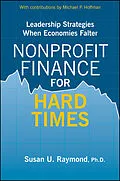
How to make strategic plan to help your nonprofit navigate
turbulent financial waters and achieve strengthened revenues
During this time of upheaval and instability with the country's
financial markets and economy, you might be wondering how your
nonprofit can emerge stronger from this unprecedented turmoil and
prepare for future economic cycles. Practical and timely,
Nonprofit Finance for Hard Times: Leadership Strategies When
Economies Falter helps your nonproft get strategic in the weak
economy.
Nonprofit Finance for Hard Times shows you how surviving
the current economic conditions means dedicating yourself to
understanding the details of the current financial crisis and
identifying those Board members and other leaders who can give you
deep analysis on the crisis and act as your analysts of the winners
and losers in real time.
* Emphasizes that the core of all strategy is engagement
* Helps you reassess your nonprofit's communications tools for
both messages and markets
* Asserts that the operative need is for strategy, not panic
* Revisits all assumptions
* Explains how to sort and cull past supporters for those who
will emerge from the turmoil first and strongest
* Reveals how to identify new audiences
Providing the guidance your nonprofit needs-not to just hang on
for the white-knuckle ride, but to plan their best strategy to
survive and succeed-Nonprofit Finance for Hard Times equips
you with the tools you need to get started.
Autorentext
SUSAN U. RAYMOND, Ph.D., is Executive Vice President for Research, Evaluation, and Strategic Planning at Changing Our World, Inc. She has extensive experience in research, analysis, and planning, most recently with the prestigious New York Academy of Sciences. Prior to this, she was a project officer at the World Bank and a consultant to the U.S. State Department and to various private organizations, including the Carnegie Corporation, specializing in health care and international eco-nomic research. Susan serves as Chief Analyst for OnPhilanthropy.com, a global resource for nonprofit professionals. She has written for many publications, particularly in the areas of economics, health care, and corporate responsibility, and is the author of two books with Wiley.
Zusammenfassung
How to make strategic plan to help your nonprofit navigate turbulent financial waters and achieve strengthened revenues
During this time of upheaval and instability with the country's financial markets and economy, you might be wondering how your nonprofit can emerge stronger from this unprecedented turmoil and prepare for future economic cycles. Practical and timely, Nonprofit Finance for Hard Times: Leadership Strategies When Economies Falter helps your nonproft get strategic in the weak economy.
Nonprofit Finance for Hard Times shows you how surviving the current economic conditions means dedicating yourself to understanding the details of the current financial crisis and identifying those Board members and other leaders who can give you deep analysis on the crisis and act as your analysts of the winners and losers in real time.
- Emphasizes that the core of all strategy is engagement
- Helps you reassess your nonprofit's communications tools for both messages and markets
- Asserts that the operative need is for strategy, not panic
- Revisits all assumptions
- Explains how to sort and cull past supporters for those who will emerge from the turmoil first and strongest
- Reveals how to identify new audiences
Providing the guidance your nonprofit needs-not to just hang on for the white-knuckle ride, but to plan their best strategy to survive and succeed-Nonprofit Finance for Hard Times equips you with the tools you need to get started.
Inhalt
List of Exhibits xi
List of Cases and Commentary xv
Preface xix
Acknowledgments xxi
About the Author xxiii
CHAPTER 1 Beginning at the Beginning: Public Charities on theEconomic Landscape 1
The Present Departs from the Past 2
A Complex and Poorly Documented Sector 4
An Economic Engine 7
Nonprofits as Masters of Their Own Fate in Economic Turmoil8
CHAPTER 2 Setting the Larger Stage: A Philosophy ofPhilanthropy 11
A Fundamental Question 12
Engagement as Differentiator 13
Passion and Leadership 14
CHAPTER 3 Philanthropy within Financial Structures: DefiningOverall Nonprofit Revenue 17
Sectoral Distinctions and Revenue Structure 19
Size Distinctions and Revenue Structure 29
Summary: The Prerequisite for Strategy Refinement in Hard Times31
CHAPTER 4 Emerging Nonprofit Revenue Parameters:Accommodating Change in the Interests of Stability 35
The Definition of a "Nonprofit" 36
Globalization of Economies, Leadership, and Philanthropy 40
Technology: The Emergence of Social Networking 41
Demographics as Destiny 45
Summary 57
CHAPTER 5 Institutions Blaze New Trails: Innovations inPhilanthropic Financial Support Strategies 61
Traditional Foundation Giving 62
New Strategies for Supporting Societal Missions 65
Cause-Related Marketing 74
Capitalizing on Innovation: The Prerequisite of Planning 77
CHAPTER 6 Does the Economy Matter? The Complexity of EconomicCycles and Nonprofit Revenues 81
The Opportunity of Cycles 82
Nonprofits and Economic Change: Treating Mission as a Sail, Notan Anchor 82
The Past Record of Private Contributions and the Economy 84
Disaggregating Data for Deeper Relationships 88
Disaggregating to the Level of State Economies 90
A Note on Government Roles 95
Five Insights to Guide Strategic Directions 95
CHAPTER 7 A Systems Approach to Revenue Strategy 103
The Imperative of Letting Go: Paradigmatic Shifts 104
The Shifting Basis for Strategy 107
The Context of an Analytic Framework for Strategy 109
Proposed Analytic Framework to Organize Strategy 114
Populating the Framework 118
CHAPTER 8 Common Principles for Robust Strategy 121
A Note on Mission 122
Strategic Principle One: Value the People 123
Strategic Principle Two: Innovate 126
Strategic Principle Three: Expect and Accept Nothing Less thanExcellence 129
Strategic Principle Four: Passion Matters but So Do Skills132
Strategic Principle Five: Know Yourself 133
CHAPTER 9 Getting Down to Specifics: Strategy for Complexity135
Understanding Movement within the Analytic Framework 135
Expressive Philanthropy: Strategy Base = Communicating SharedValues 137
Rising Expectations: Strategy Base = Evidence and InterestAlignment 143
Quasi-Markets: Strategy Base = Competitive Self-Reliance 151
Pure Markets: Strategy Base = Linking to Outside CommercialSuccess 157
Crossing the Strategy Area Boundaries 161
CHAPTER 10 Prevent Where Possible, Cure Where Necessary:Strategic Steps to Prepare for and Respond to Economic Crisis165
Steps to Prevent Organizational Crisis in Economic Hard Times166
Steps to Cure the Effects of Organizational Crisis in EconomicHard Times 172
Final Comments: A Call to Leadership 175
CHAPTER 11 Reprise on Philanthropy: Why Bother? 177
CHAPTER 12 Making a Difference in the World by AligningYourself with the Poor 181
Index 191