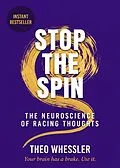
What if your racing mind isn't a personal flaw, but a predictable feature of your brain that you can actually learn to work with?
Lying awake as one thought triggers the next. Replaying awkward conversations. Rehearsing tomorrow's worst-case scenarios. If your mind never seems to stop spinning, you are not broken, and you are far from alone. In Stop the Spin, neuroscientist Theo Whessler reveals what is really happening inside an overthinking brain, from the default mode network to the amygdala's threat alarms, and translates decades of laboratory research into simple, practical tools.
This is not vague advice to "just relax." It is a clear, evidence-based map of why you spiral and exactly how to interrupt the loop, one small habit at a time.
Inside, you'll discover:
- How to map your personal triggers and catch anxiety at its earliest signal, before it spirals out of control
- Somatic resets and breathing techniques that calm your nervous system through the body, not just the mind
- The 4 A's framework for matching the right coping strategy to the right kind of problem
- How to rewrite your inner monologue and sidestep the cognitive traps that fuel needless worry
- The counterintuitive power of a scheduled worry period, journaling, and grounding practices that actually work
- How sleep, nutrition, movement, and your digital environment quietly shape your capacity to stay calm
You may never silence your mind completely, but you can stop being ruled by it. The spin can slow, and this book shows you how.
Autorentext
Theo Whessler is an Austrian neuroscientist and nonfiction author who studies the systematic errors the brain makes against our will, at work, in investing, in relationships, and in decision-making. He studied biology and cognitive science at a leading German-speaking university and earned a doctorate in the neuroscience of decision-making. For roughly fifteen years he worked at a major European research institute, specializing in neuroimaging, risk modeling, and the systematic biases of perception. Recognizing that laboratory findings rarely reach the people who make decisions every day, he turned his focus to writing and closed advisory work. Today he runs an independent author's practice, advises investors and executives, and leads small cohort programs for analysts. He writes short, applied books that translate laboratory neuroscience into practical rules for everyday life.