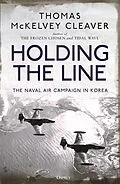
This is the gripping story of Task Force 77, the US Navy carrier commitment to the Korean War that was vital to the success of the UN forces battling the Chinese and North Koreans.
Naval and air power were crucial to the United Nations' success in the Korean War, as it sought to negate the overwhelming Chinese advantage in manpower. In what became known as the 'long hard slog', naval aviators sought to slow and cut off communist forces and support troops on the ground.
USS Leyte (CV-32) operated off Korea in the Sea of Japan for a record 93 continuous days to support the Marines in their epic retreat out of North Korea, and was crucial in the battles of the spring and summer of 1951 in which the UN forces again battled to the 38th Parallel.
All of this was accomplished with a force that was in the midst of change, as jet aircraft altered the entire nature of naval aviation. Holding the Line chronicles the carrier war in Korea from the first day of the war to the last, focusing on front-line combat, while also describing the technical development of aircraft and shipboard operations, and how these all affected the broader strategic situation on the Korean Peninsula.
Autorentext
Thomas McKelvey Cleaver has been a published writer for the past 40 years, with his most recent work being the best-selling Osprey titles The Frozen Chosen (2016), Pacific Thunder (2017), Tidal Wave (2018), Holding the Line (2019), MiG Alley (2019), and I Will Run Wild (2020). He is also the author of Aces of the 78th Fighter Group and F4F Wildcat and F6F Hellcat Aces of VF-2, as well as Fabled Fifteen: The Pacific War Saga of Carrier Air Group 15 and The Bridgebusters: The True Story of the Catch-22 Bomb Group. During his 30 years as a screenwriter in Hollywood, he wrote the cult classic The Terror Within and worked as a supervising producer on a number of TV and cable series. He served in the US Navy in Vietnam and currently lives in Encino, California.
Klappentext
Naval and air power were crucial to the United Nations' success in the Korean War, as it sought to negate the overwhelming Chinese advantage in manpower. In what became known as the 'long hard slog', naval aviators sought to slow and cut off communist forces and support troops on the ground. USS Leyte (CV-32) operated off Korea in the Sea of Japan for a record 93 continuous days to support the Marines in their epic retreat out of North Korea, and was crucial in the battles of the spring and summer of 1951 in which the UN forces again battled to the 38th Parallel.
All of this was accomplished with a force that was in the midst of change, as jet aircraft altered the entire nature of naval aviation. Holding the Line chronicles the carrier war in Korea from the first day of the war to the last, focusing on front-line combat, while also describing the technical development of aircraft and shipboard operations, and how these all affected the broader strategic situation on the Korean Peninsula.
Inhalt
Foreword by Dr. Richard P. Hallion
Introduction
Chapter 1: Climb Angels Two-Five - Buster!
Chapter 2: The Revolt of the Admirals
Chapter 3: Forging a New Sword
Chapter 4: Naval Aviation Saves Itself
Chapter 5: Defeat Looms
Chapter 6: Inchon
Chapter 7: A Whole New War
Chapter 8: Disaster
Chapter 9: Holding the Line
Chapter 10: The Battle of Carlson' s Canyon and the Hwachon Dam
Chapter 11: Weekend Warriors
Chapter 12: Operation Strangle
Chapter 13: "Death Valley"
Chapter 14: Who Owns the Night?
Chapter 15: The Cherokee
Chapter 16: The West Coast
Chapter 17: The Marine War
Chapter 18: The End in Sight
Chapter 19: The War Assessed
Bibliography
Index