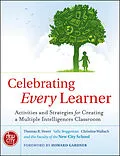
Howard Gardner's groundbreaking theory applied for classroom use This important book offers a practical guide to understanding how Howard Gardner's theory of Multiple Intelligences (MI) can be used in the classroom. Gardner identified eight different types of intelligence: linguistic, logical, spatial, musical, bodily-kinesthetic, naturalist, interpersonal, and intrapersonal. Celebrating Every Learner describes the characteristics of each type of intelligence and follows up with ready-to-use lesson plans and activities that teachers can use to incorporate MI in their pre-K through 6 classrooms. * Offers a treasury of easily implemented activities for engaging all students' multiple intelligences, from the New City School, a leading elementary school at the forefront of MI education * Provides ready-to-use lesson plans that teachers can use to incorporate MI in any elementary classroom * Includes valuable essays on how and why to integrate MI in the classroom * Hoerr is the author of a bi-monthly column for Educational Leadership as well as the editor of the "Intelligence Connections" e-newsletter
Autorentext
Thomas R. Hoerr, Ph.D. is the Head of School at the New City School in St. Louis, Missouri. He is also the author of Becoming a Multiple Intelligences School, The Art of School Leadership, and School Leadership for the Future, as well as many articles and book chapters.
Sally Boggeman, Christine Wallach, and all of the other contributors are the dedicated teachers of the New City School.
Klappentext
Howard Gardner's groundbreaking theory applied for classroom
use
This important book offers a practical guide to understanding
how Howard Gardner's theory of Multiple Intelligences (MI) can be
used in the classroom. Gardner identified eight different types of
intelligence: linguistic, logical, spatial, musical,
bodily-kinesthetic, naturalist, interpersonal, and intrapersonal.
Celebrating Every Learner describes the characteristics of
each type of intelligence and follows up with ready-to-use lesson
plans and activities that teachers can use to incorporate MI in
their pre-K through 6 classrooms.
* Offers a treasury of easily implemented activities for engaging
all students' multiple intelligences, from the New City School, a
leading elementary school at the forefront of MI education
* Provides ready-to-use lesson plans that teachers can use to
incorporate MI in any elementary classroom
* Includes valuable essays on how and why to integrate MI in the
classroom
* Hoerr is the author of a bi-monthly column for Educational
Leadership as well as the editor of the "Intelligence
Connections" e-newsletter
Zusammenfassung
Howard Gardner's groundbreaking theory applied for classroom use
This important book offers a practical guide to understanding how Howard Gardner's theory of Multiple Intelligences (MI) can be used in the classroom. Gardner identified eight different types of intelligence: linguistic, logical, spatial, musical, bodily-kinesthetic, naturalist, interpersonal, and intrapersonal. Celebrating Every Learner describes the characteristics of each type of intelligence and follows up with ready-to-use lesson plans and activities that teachers can use to incorporate MI in their pre-K through 6 classrooms.
- Offers a treasury of easily implemented activities for engaging all students' multiple intelligences, from the New City School, a leading elementary school at the forefront of MI education
- Provides ready-to-use lesson plans that teachers can use to incorporate MI in any elementary classroom
- Includes valuable essays on how and why to integrate MI in the classroom
- Hoerr is the author of a bi-monthly column for Educational Leadership as well as the editor of the "Intelligence Connections" e-newsletter
Inhalt
Acknowledgments v
Foreword by Howard Gardner xiii
Introduction by Thomas R. Hoerr 1
Part 1. The Multiple Intelligences
CHAPTER 1 The Interpersonal Intelligence
Web of the Interpersonal Intelligence 8
The Interpersonal Intelligence by Laurie Falk 9
Lesson Plans:
Picture This! 12
The House We Built 15
Making Museums 16
Getting to Know You 18
Masai Jewelry 19
Rainforest Simulation 21
Gold Rush Inventions 27
Unfairness on Purpose: A Problem-Solving Mind-Set 29
Activities to Support the Interpersonal Intelligence 31
Identifying the Interpersonal Intelligence in Your Students 32
Children's Resources 36
Teachers' Resources 39
CHAPTER 2 The Intrapersonal Intelligence
Web of the Intrapersonal Intelligence 42
Intrapersonal Is the Key to Success by Thomas R. Hoerr 43
Lesson Plans:
Me Bags 48
I Am . . . 50
Content of Their Character 51
Goal Setting 53
Autobiography: My Story 55
Letter to Myself 57
What I Believe 59
Simile for Me 61
Activities to Support the Intrapersonal Intelligence 65
Identifying the Intrapersonal Intelligence in Your Students 66
Children's Resources 68
Teachers' Resources 72
CHAPTER 3 The Bodily-Kinesthetic Intelligence
Web of the Bodily-Kinesthetic Intelligence 76
The B-K Everyday by Pat Nuernberger, Tommi Rogers, and Lauren
McKenna 77
Lesson Plans:
Everybody's Moving 81
Express Yourself 83
Continental Twister 85
Sensing Our Bodies 86
Literature Live 88
Prepositional Charades 90
Disabilities Simulation 92
Living Museum 96
Activities to Support the Bodily-Kinesthetic Intelligence 99
Identifying the Bodily-Kinesthetic Intelligence in Your Students 100
Children's Resources 101
Teachers' Resources 103
CHAPTER 4 The Linguistic Intelligence
Web of the Linguistic Intelligence 106
The Multiple Intelligences Library by Joe Corbett and Jessica Brod-Millner 107
Lesson Plans:
Word Work 111
Poetry 113
Spanish Scavenger Hunt 115
Book Reports the MI Way 117
Sincerely Yours: Parts of a Letter 119
Living History 120
Extra, Extra, Read All About It 122
Literature Responses 124
Activities to Support the Linguistic Intelligence 126
Identifying the Linguistic Intelligence in Your Students 127
Children's Resources 130
Teachers' Resources 135
CHAPTER 5 The Logical-Mathematical Intelligence
Web of the Logical-Mathematical Intelligence 138
The Logical-Mathematical Intelligence: Identifi cation and Implementation by Chanaya Jacobs and Claire Reinbold 139
Lesson Plans:
Numbers 143
Measurement Drawing 146
Scaling the Miles 148
Mathematical Masterpieces 150
Civil War Mural and Timeline 154
Speed Demons 156
Everything and the Net 158
Restaurant Project 160
Activities to Support the Logical-Mathematical Intelligence 162
Identifying the Logical-Mathematical Intelligence in Your Students 163
Children's Resources 165
Teachers' Resources 169
CHAPTER 6 The Musical Intelligence
Web of the Musical Intelligence 172
Minding the Music by Ben Griffi ths 173
Lesson Plans:
Digestion in the Human Body 176
Caterpillars to Butterfl ies 178
Human Rhythm 180&l...