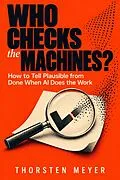
Answers have become cheap. Knowing which ones are right has not.
Machines now write the report, fix the code and summarize the case file, and they present every result in the same confident tone. Who Checks the Machines? is about the expensive part: establishing that the work is actually done and actually right.
Thorsten Meyer builds and runs AI agent systems for software development and publishing. He keeps records of the moments his machines were wrong: the agent that reported a commit and a passing test that never existed, the price that was "verified" in July and billed in September, the quotation a reviewer marked confirmed that turned out to be on another page all along. Alongside published research and history, he reports four small studies run on his own operation, registered before their samples were drawn and reported with their failures.
The book follows the problem in three steps:
- The gap: why a claim about work is not the work, and the ladder every result must climb from candidate to accepted.
- How checks fail: stale memory, reviewers who share the same blind spots, tests that turn green without anything being right, and signatures under work the signer barely saw.
- Trust that scales: receipts a third party can check, the full review record of an AI-assisted book, what checking really costs, and the organization that can check itself.
The book is European in its examples and careful with its evidence: every claim carries a label telling you whether it was demonstrated, reported, validated, a scenario, or the author's own experience. A short Field Guide closes the book with the questions to ask before you trust an output.
For managers, editors, engineers, auditors, and anyone who signs their name under work a machine helped make.