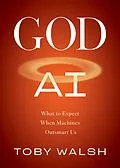
For decades, some theoretical scientists have suggested that AI will lead to the extinction of humanity . . .
Fearing the singularity-the point at which the development of artificial intelligence will outpace our capacity to control it-some scientists are sounding the alarm that a powerful AI could threaten our very existence as a species. More optimistic experts suggest that, properly regulated, AI will be a great boon to humanity-dramatically increasing the efficiency of scientific research and medical treatment.
Both are very real possibilities, says leading, long-time artificial intelligence researcher Toby Walsh. In God AI, Walsh draws upon over-forty years experience, to explain the history and the future of AI's role in computing. He explores both the possibility of enormously positive outcomes, as well as the existential risks posed by accelerating headlong into an AI-powered future.
With great clarity and humor, Walsh gives us a manual to understanding how we actually use this technology, and how we can safely steer it into the future-before it accelerates out of our control.
Autorentext
Toby Walsh is Scientia Professor of Artificial Intelligence at the University of New South Wales and a Fellow of the Australia Academy of Science. He is an advocate for limits to ensure AI is used to improve our lives, and has been a leading voice in the discussion about lethal autonomous weapons (aka killer robots), speaking at the UN in New York and Geneva on the topic. He appears regularly on TV and radio, and is the author of Machines Behaving Badly: The Morality of AI, and Machines that Think: The Future of Artificial Intelligence. Dr. Walsh lives in Sydney.