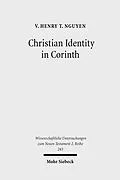
V. Henry T. Nguyen explores the social dynamics of Christian identity in the apostle Paul's second letter to the Corinthians. In order to grasp how aspects of identity affected social relations in the world of the New Testament, the author examines the significance of the ancient concept of persona for denoting a person's social identity in the Graeco-Roman social world. In addition to describing this social concept, which has been largely ignored by New Testament scholars and classicists, he considers two figures - Epictetus and Valerius Maximus - for their perceptions of social identity and persona in the Graeco-Roman world. By exploring this ancient concept and contributing new insights into Epictetus and Valerius, the author demonstrates the existence of a large preoccupation with the superficial features that expressed identity and persona (e.g. rank, status, and eloquence). He then investigates 2 Corinthians and argues that some of the conflicts in the Corinthian church resulted from the Corinthian Christians' adoption of the conventional values of identity and persona that were prevalent in Corinth. Paul's conflict with the Corinthians is clearly seen in their superficial assessment of his persona as lacking the appropriate credentials for an apostle. The author shows that in order to combat this misconception of Christian identity in the Corinthian church, Paul reacted to the Corinthians' conventional values of identity by promoting and projecting a subversive Christ-like identity, which is a visible embodiment of the dying and life of Jesus Christ.
Born 1977; B.A. Life Pacific College (USA); M.A. Talbot School of Theology, Biola University (USA); PhD University of Aberdeen (UK); currently teaching at Loyola Marymount University and Biola University in Los Angeles, USA.
Autorentext
Zusammenfassung
V. Henry T. Nguyen untersucht die soziale Dynamik der christlichen Identität im zweiten Brief des Apostels Paulus an die Korinther. Um zu erfassen, wie diese Identität die sozialen Beziehungen in der Welt des Neuen Testaments beeinflußte, untersucht er das Konzept der persona und die Wahrnehmung der sozialen Identität und der persona bei Epiktet und Valerius Maximus. Dabei kommt er zu dem Ergebnis, daß in der griechisch-römischen Gesellschaft ein Identitätsbild vorherrschte, das großen Wert auf Äußerlichkeiten legte. Anhand des Korinterherbriefes zeigt Nguyen, wie Paulus gegen dieses Mißverständnis christlicher Identität in der Kirche vorging und eine Christus-ähnliche Identität förderte, die im Sterben und Leben Jesu Christi offenbar wird.
Born 1977; B.A. Life Pacific College (USA); M.A. Talbot School of Theology, Biola University (USA); PhD University of Aberdeen (UK); currently teaching at Loyola Marymount University and Biola University in Los Angeles, USA.
Autorentext
Born 1977; B.A. Life Pacific College (USA); M.A. Talbot School of Theology, Biola University (USA); PhD University of Aberdeen (UK); currently teaching at Loyola Marymount University and Biola University in Los Angeles, USA.
Zusammenfassung
V. Henry T. Nguyen untersucht die soziale Dynamik der christlichen Identität im zweiten Brief des Apostels Paulus an die Korinther. Um zu erfassen, wie diese Identität die sozialen Beziehungen in der Welt des Neuen Testaments beeinflußte, untersucht er das Konzept der persona und die Wahrnehmung der sozialen Identität und der persona bei Epiktet und Valerius Maximus. Dabei kommt er zu dem Ergebnis, daß in der griechisch-römischen Gesellschaft ein Identitätsbild vorherrschte, das großen Wert auf Äußerlichkeiten legte. Anhand des Korinterherbriefes zeigt Nguyen, wie Paulus gegen dieses Mißverständnis christlicher Identität in der Kirche vorging und eine Christus-ähnliche Identität förderte, die im Sterben und Leben Jesu Christi offenbar wird.
Titel
Christian Identity in Corinth
Untertitel
A Comparative Study of 2 Corinthians, Epictetus, and Valerius Maximus
Autor
EAN
9783161515866
Format
E-Book (pdf)
Hersteller
Digitaler Kopierschutz
Adobe-DRM
Dateigrösse
1.11 MB
Anzahl Seiten
284
Unerwartete Verzögerung
Ups, ein Fehler ist aufgetreten. Bitte versuchen Sie es später noch einmal.